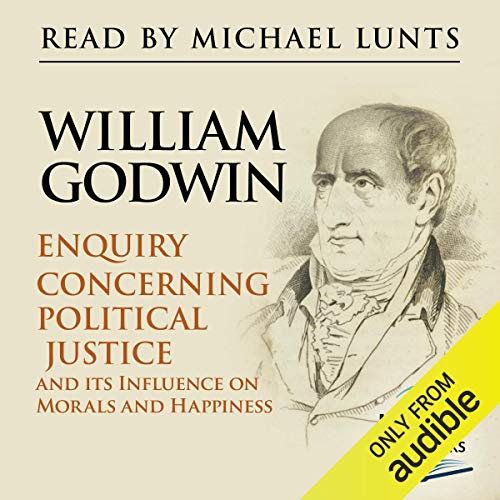
Enquiry Concerning Political Justice - William Godwin
Language: EnglishKeywords:
Equality
Happiness
Morals
Philosophy
Political Theory
Tyranny
Shared by:userabuser
Written by
Read by Michael Lunts
Format: MP3
Bitrate: 64 Kbps
Unabridged
Enquiry Concerning Political Justice
And Its Influence on Morals and Happiness
By: William Godwin
Narrated by: Michael Lunts
Length: 27 hrs and 49 mins
Audiobook
Release date: 09-30-20
Language: English
Publisher: Ukemi Audiobooks
Publisher’s Summary
Enquiry Concerning Political Justice and Its Influence on Morals and Happiness by William Godwin (1756-1836) was first published in February 1793, the month following the execution of Louis XVI of France.
It proved to be immediately popular and influential. Godwin, the son of a Calvinist preacher, was educated at Hoxton Academy, after which, he became a minister to a dissenter congregation in Ware. However, partially as a result of reading Rousseau, Helvetius and d’ Holbach, his thinking changed and he left the ministry in 1783, the year the American war of Independence ended, by which point he had become a complete sceptic in matters of religion and turned to philosophy and ultimately to anarchism for the truth.
This was to be a period of huge political turmoil and continuing uncertainty, which had seen revolution in America and France, as well as the madness of King George III and the Regency crisis. It was a time of Whigs and Tories, of frenzied political argument and a flood of political pamphlet publishing.
The Enquiry came hot on the heels of Edmund Burke’s Reflections on the Revolution in France (1790) and Thomas Paine’s Rights of Man (1791-1792) in a time that witnessed severe government repression of civil liberties. In essence it is a wide- ranging disquisition on moral and political philosophy. Its central message or theme is that of the potential for human perfectibility through the pursuit of reason and truth.
At times it has a visionary quality, which perhaps explains why its publication was met with such delighted excitement and approval by the young Romantic poets, Wordsworth, Coleridge, Shelley and others. It appeared in a moment of great optimism, when there was a sense that the revolution would lead to sweeping reforms and the abolition of ancient abuses of privilege and inequality and hopes that traditional antagonisms and hostilities between England and France would soon come to an end.
For a brief period Godwin was very much the toast of the town, but as the excesses of the Terror mounted in France and the heads rolled beneath the guillotine, thinking changed, attitudes hardened and the mood darkened. Godwin’s star fell as rapidly as it had risen. England and France would go to war and as quickly as Godwin had been taken up by the young radicals he was cast aside by them as they matured into conservatives, both socially and politically, rejecting many of the ideas that had seemed so appealing to their younger selves.
Godwin was seen as a figurehead for dangerous ideas and as being a representative of the somewhat wilder and more extreme ideas of the young Jacobins. Consequently, he became a scapegoat to be satirised and attacked. It is important to note, however, that although his book was published during revolutionary times Godwin, who was spoken of in social circles as ‘The Philosopher’, never advocated violent revolutionary change but indeed insisted that change had to come about gradually and peacefully. He argued that people had to be persuaded, not coerced and advocated systematic philosophical radicalism since history had demonstrated that those who overthrew tyrants with violence frequently became tyrants themselves. Godwin’s anarchist vision of society comprises three basic principles: ‘political simplicity’, ‘public inspection’ and ‘positive sincerity’. He declares in effect that there must be a complete restructuring of human society, prefiguring later thinkers such as Marx in maintaining that the masses had been misled on account of the ‘mysterious and complicated nature of the social system’.
Likewise, he explains most crime as resulting from economic inequality which would cease once there was a more egalitarian distribution of wealth. In general terms he argues for a combination of federalism and increased localism and envisages a system founded on sincerity, open and honest discourse and truth that would be answerable to the public through a process ‘of public inspection’ and censorship, driven by benevolence.
His wish was to usher in a new anarchist order which would see an end to imperialism, state terror and legalised murder. He stated: “Sound reasoning and truth, when adequately communicated, must always be victorious over error: Sound reasoning and truth are capable of being so communicated: Truth is omnipotent: The vices and moral weakness of man are not invincible: Man is perfectible, or in other words susceptible of perpetual improvement.”
His ideas are as relevant and as worthy of consideration in today’s troubled political climate as when they were written. Enquiry Concerning Political Justice and Its Influence on Morals and Happiness, Third Edition is read for Ukemi Audiobooks by Michael Lunts.
Public Domain (P)2020 Ukemi Productions Ltd

| Announce URL: | http://googer.cc:1337/announce |
| This Torrent also has several backup trackers | |
| Tracker: | http://googer.cc:1337/announce |
| Tracker: | http://open.acgnxtracker.com:80/announce |
| Tracker: | http://tracker2.dler.org:80/announce |
| Tracker: | udp://exodus.desync.com:6969/announce |
| Tracker: | udp://open.stealth.si:80/announce |
| Tracker: | udp://opentor.org:2710/announce |
| Tracker: | udp://tracker.dler.org:6969/announce |
| Tracker: | udp://tracker.opentrackr.org:1337/announce |
| Tracker: | udp://tracker.tiny-vps.com:6969/announce |
| Tracker: | udp://tracker.torrent.eu.org:451/announce |
| Tracker: | http://tracker.files.fm:6969/announce |
| Creation Date: | Mon, 31 Oct 2022 02:03:12 +0100 |
| This is a Multifile Torrent | |
| 01. Introduction by Mark G. Spencer.mp3 10.2 MBs | |
| 02. Preface (7 January 1793).mp3 4.52 MBs | |
| 03. Preface to the Second Edition (29 October 1795).mp3 3.61 MBs | |
| 04. Summary of Principles.mp3 3.1 MBs | |
| 05. Book I - Of the Powers of Man Considered in His Social Capacity.mp3 3.61 MBs | |
| 06. II - History of Political Society.mp3 5.81 MBs | |
| 07. III - Spirit of Political Institutions.mp3 7.61 MBs | |
| 08. IV - The Characters of Men Originate in their External Circumstances.mp3 20.37 MBs | |
| 09. V - The Voluntary Actions of Men Originate in their Opinions.mp3 33.33 MBs | |
| 10. VI - Of the Influence of Climate.mp3 7.1 MBs | |
| 11. VII - Of the Influence of Luxury.mp3 3.35 MBs | |
| 12. VIII - Human Inventions Susceptible of Perpetual Improvement.mp3 6.4 MBs | |
| 13. Book II - Principles of Society.mp3 3.17 MBs | |
| 14. II - Of Justice.mp3 9.73 MBs | |
| 15. Appendix I - Of Suicide.mp3 1.61 MBs | |
| 16. Appendix II - Of Duelling.mp3 2.43 MBs | |
| 17. III - Of the Equality of Mankind.mp3 3.49 MBs | |
| 18. IV - Of Personal Virtue and Duty.mp3 7.75 MBs | |
| 19. V - Of Rights.mp3 9.11 MBs | |
| 20. VI - Of the Right of Private Judgement.mp3 9.49 MBs | |
| 21. Book III - Principles of Government.mp3 3.34 MBs | |
| 22. II - Of the Social Contract.mp3 4.37 MBs | |
| 23. III - Of Promises.mp3 15.13 MBs | |
| 24. IV - Of Political Authority.mp3 5.01 MBs | |
| 25. V - Of Legislation.mp3 1.39 MBs | |
| 26. VI - Of Obedience.mp3 12.43 MBs | |
| 27. VII - Of Forms of Government.mp3 5.42 MBs | |
| 28. Book IV - Of the Operation of Opinion in Societies and Individuals.mp3 12.31 MBs | |
| 29. II - Of Revolutions.mp3 16.2 MBs | |
| 30. III - Of Political Associations.mp3 11.45 MBs | |
| 31. IV - Of Tyrannicide.mp3 3.28 MBs | |
| 32. V - Of the Cultivation of Truth.mp3 7.92 MBs | |
| 33. Appendix - Of the Connection between Understanding and Virtue.mp3 8.72 MBs | |
| 34. VI - Of Sincerity.mp3 10.92 MBs | |
| 35. Appendix I - Illustrations of Sincerity.mp3 11.98 MBs | |
| 36. Appendix II - Of the Mode of Excluding Visitors.mp3 2.76 MBs | |
| 37. VII - Of Free Will and Necessity.mp3 16.89 MBs | |
| 38. VIII - Inferences from the Doctrine of Necessity.mp3 10.16 MBs | |
| 39. IX - Of the Mechanism of the Human Mind.mp3 17.81 MBs | |
| 40. X - Of Self-love and Benevolence.mp3 13.25 MBs | |
| 41. XI - Of Good and Evil.mp3 18.68 MBs | |
| 42. Book V - Of Legislative and Executive Power.mp3 3.08 MBs | |
| 43. II - Of Education, the Education - of a Prince.mp3 10.5 MBs | |
| 44. III - Private Life of a Prince.mp3 7.85 MBs | |
| 45. IV - Of a Virtuous Despotism.mp3 4.45 MBs | |
| 46. V - Of Courts and Ministers.mp3 8.36 MBs | |
| 47. VI - Of Subjects.mp3 9.14 MBs | |
| 48. VII - Of Elective Monarchy.mp3 5.17 MBs | |
| 49. VIII - Of Limited Monarchy.mp3 9.8 MBs | |
| 50. IX - Of a President with Regal Powers.mp3 5.12 MBs | |
| 51. X - Of Hereditary Distinction.mp3 5.12 MBs | |
| 52. XI - Moral Effects of Aristocracy.mp3 4.72 MBs | |
| 53. XII - Of Titles.mp3 2.91 MBs | |
| 54. XIII - Of the Aristocratical Character.mp3 8.02 MBs | |
| 55. XIV - Of the General Features of Democracy.mp3 6.98 MBs | |
| 56. XV - Of Political Imposture.mp3 12.41 MBs | |
| 57. XVI - Of the Causes of War.mp3 7.91 MBs | |
| 58. XVII - Of the Object of War.mp3 3.71 MBs | |
| 59. XVIII - Of the Conduct of War.mp3 6.63 MBs | |
| 60. XIX - Of Military Establishments and Treaties.mp3 6.69 MBs | |
| 61. XX - Of Democracy as Connected with the Transactions of War.mp3 5.27 MBs | |
| 62. XXI - Of the Composition of Government.mp3 5.82 MBs | |
| 63. XXII - Of the Future History of Political - Societies.mp3 7.08 MBs | |
| 64. XXIII - Of National Assemblies.mp3 5.77 MBs | |
| 65. XXIV - Of the Dissolution of Government.mp3 2.51 MBs | |
| 66. Book VI - Of Opinion Considered As a Subject of Political Institution.mp3 15.13 MBs | |
| 67. II - Of Religious Establishments.mp3 5.05 MBs | |
| 68. III - Of the Suppression of Erroneous Opinions in Religion and Government.mp3 9.97 MBs | |
| 69. IV - Of Tests.mp3 6.2 MBs | |
| 70. V - Of Oaths.mp3 4.27 MBs | |
| 71. VI - Of Libels.mp3 11.43 MBs | |
| 72. VII - Of Constitutions.mp3 10.23 MBs | |
| 73. VIII - Of National Education.mp3 6.46 MBs | |
| 74. IX - Of Pensions and Salaries.mp3 8.95 MBs | |
| 75. X - Of the Modes of Deciding a Question on the Part of the Community.mp3 3.36 MBs | |
| 76. Book VII - Of Crimes and Punishment.mp3 5.63 MBs | |
| 77. II - General Disadvantages of Punishment.mp3 6.47 MBs | |
| 78. III - Of the Purposes of Punishment.mp3 7.46 MBs | |
| 79. IV - Of the Application of Punishment.mp3 9.1 MBs | |
| 80. V - Of Punishment Considered as a Temporary Expedient.mp3 14 MBs | |
| 81. VI - Scale of Punishment.mp3 11.41 MBs | |
| 82. VII - Of Evidence.mp3 2.13 MBs | |
| 83. VIII - Of Law.mp3 12.84 MBs | |
| 84. IX - Of Pardons.mp3 4.74 MBs | |
| 85. Book VIII - Of Property.mp3 7.69 MBs | |
| 86. II - Principles of Property.mp3 16.47 MBs | |
| 87. III - Benefits Attendant on a System of Equality.mp3 10.56 MBs | |
| 88. IV - Objection to this System from the Frailty of the Human Mind.mp3 4.64 MBs | |
| 89. V - Objection to this System from the Question of Permanence.mp3 3.61 MBs | |
| 90. VI - Objection to this System from the Allurements of Sloth.mp3 6.97 MBs | |
| 91. VII - Objection to this System from the Benefits of Luxury.mp3 4.09 MBs | |
| 92. VIII - Objection to this System from the Inflexibility of its Restrictions.mp3 2.61 MBs | |
| 93. Appendix - Of Co-operation, Cohabitation and Marriage.mp3 11.58 MBs | |
| 94. IX - Objection to this System from the Principle of Population.mp3 2.97 MBs | |
| 95. Appendix - Of Health and the Prolongation of Human Life.mp3 7.53 MBs | |
| 96. X - Reflections.mp3 18.17 MBs | |
| William Godwin - Enquiry Concerning Political Justice [Oxford].epub 1.64 MBs | |
| William Godwin - Enquiry Concerning Political Justice [Penguin].epub 1 MB | |
| William Godwin - Enquiry Concerning Political Justice.jpg 78.18 KBs | |
| William Godwin - Enquiry Concerning Political Justice.txt 5.01 KBs | |
| Combined File Size: | 774.67 MBs |
| Piece Size: | 1 MB |
| Comment: | Updated by AudioBook Bay |
| Encoding: | UTF-8 |
| Info Hash: | c7d34da03909b1a765e41150c078f98fd31f9969 |
| Torrent Download | Torrent Free Downloads |
| Tips | Sometimes the torrent health info isn’t accurate, so you can download the file and check it out or try the following downloads. |
| Direct Download | Start Direct Download |
| Tips | You could try out alternative bittorrent clients. |
| Secured Download | Download Files Now |
| Ad |

|


This post has one comment with rating of 5/5
November 3rd, 2022
Thank you.
Add a comment (please log in before commenting)